A Different Kind of Luck: The Four-Leaf Clover and the Search for Authentic Self
Every year around St. Patrick’s Day, we all collectively agree to believe in luck again.
We wear green (or risk getting pinched—because that was somehow a completely acceptable childhood policy), we talk about leprechauns like we didn’t quietly retire that belief sometime around the same era as dial-up internet, and at least one person squints at a patch of grass and confidently says, “I think I found one.”
You didn’t. But I respect the commitment.
Because if you’ve ever actually tried to find a four-leaf clover, you know it’s less magical discovery and more crouching in your yard for 20 minutes questioning your life choices.
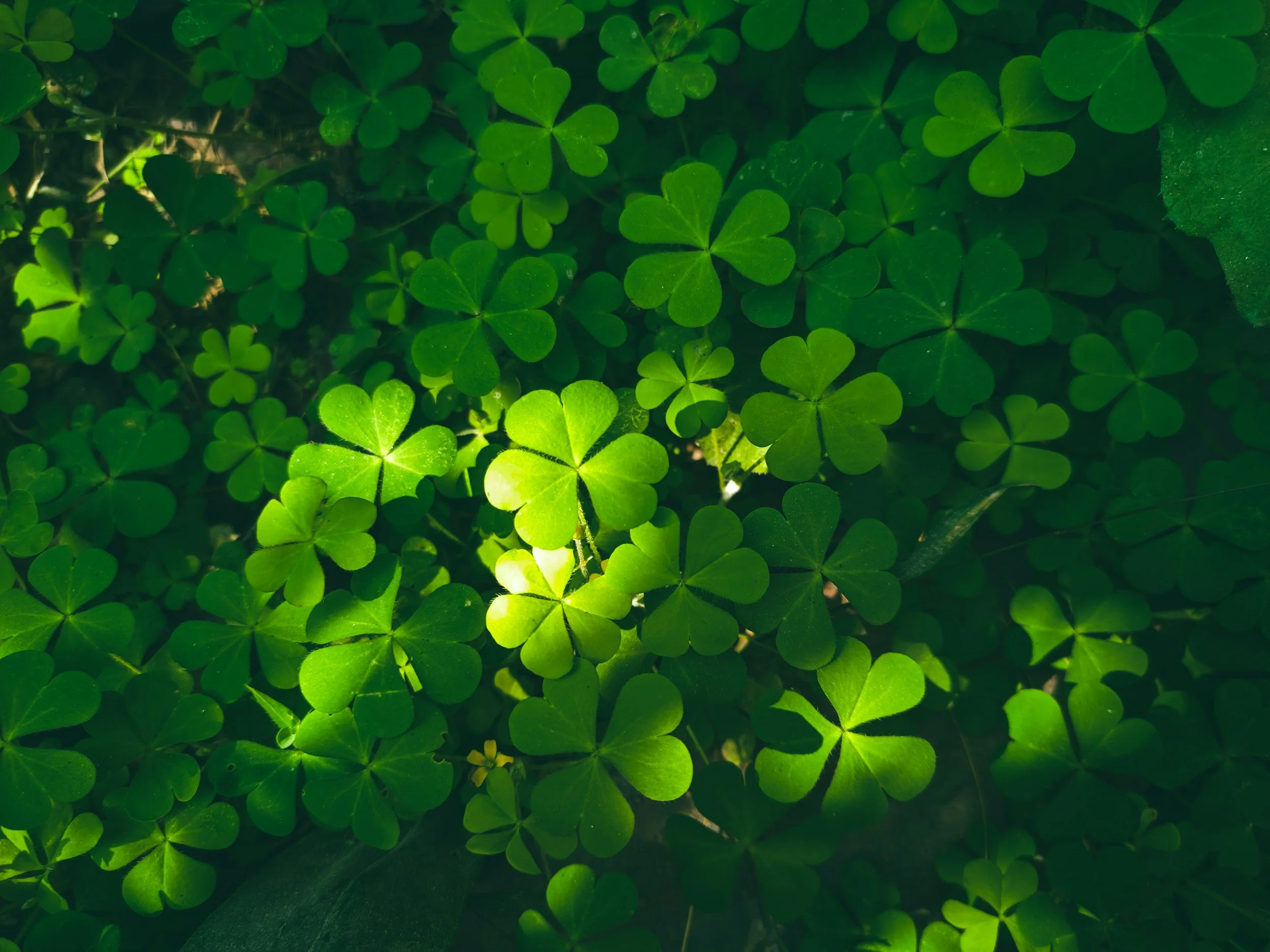
And yet—the symbol sticks.
Traditionally, the four leaves stand for faith, hope, love… and luck. But at some point, most of us realize luck is not exactly a dependable life plan. It’s more like a bonus feature that shows up occasionally and sometimes disappears when you actually need it.
So here’s a different take.
What if the “four leaves” that actually shape a meaningful life aren’t about luck at all—but about a deeper unfolding that tends to happen quietly and yes, sometimes more gradually than we would wish?
Something more like: self-knowledge, self-acceptance, self-gift, and self-transcendence.
Not flashy. But deeply solid.
🍀 Leaf One: Self-Knowledge — “Who am I, really?”
Self-knowledge sounds simple, but it turns out to be one of the more demanding things we’re asked to do.
It’s easy to know the surface-level version of yourself—what you like, what you’re good at, how you present to other people. It’s much harder to notice the patterns underneath: the ways you react when you feel overlooked, the habits you fall back on when you’re stressed, the things you avoid because they feel just a little too close to the truth.
This is the kind of knowing that requires you to slow down long enough to actually pay attention—which, in fairness, is not something most of us were taught to do.
St. John Paul II, in Love and Responsibility, emphasizes that the person is never merely an object to be used or managed, but a subject to be understood and encountered. That includes your own inner life. You are not a project—you are a person.
Self-knowledge asks for honesty—about your strengths, yes, but also about your blind spots, your fears, and your deeper desires. It’s less like finding a clover and more like cleaning out a closet you’ve been ignoring for years. You might find something valuable. You might also find magazines from the 90’s that you told yourself you’d read later and a charger to a device you no longer own.
Both are part of the process.
🍀 Leaf Two: Self-Acceptance — “Can I be with myself as I am?”
Once you start to see yourself more clearly, you arrive at a crossroads: you can either turn that awareness into growth—or into self-criticism. Most of us, if we’re being honest, have some experience with the second option.
Self-acceptance is not the same as complacency. It’s not “this is just who I am, so nothing needs to change.” It’s the steadier, more grounded ability to acknowledge reality without immediately trying to either defend it or tear it down. It’s the ability to say, “This is part of my story right now,” without adding, “and therefore I am fundamentally broken.”
St. John Paul II reminds us that our worth is not something we earn by getting everything right. It is already present. In this way, we don’t become worthy at the point when we’re “fixed.” We begin worthy, and from that place, we grow.
With this, however—unfortunately—you don’t get to motivate yourself through relentless self-criticism forever. That strategy tends to work just well enough to keep going… but poorly enough to keep you constantly chasing while feeling further and further from your goals.
Self-acceptance is more like learning to stand on solid ground. It doesn’t solve everything immediately, but it gives you a place to begin.
🍀 Leaf Three: Self-Gift — “Am I willing to give myself away?”
This is where things take a turn that doesn’t always match the messaging we hear around us.
Because once you know yourself and accept yourself, the next step is not to endlessly refine yourself, curate yourself, or protect your time and energy at all costs.
It’s self-gift.
St. John Paul II returns to this theme repeatedly, particularly in Gaudium et Spes (which he frequently cited and developed), where we find the line: “man… cannot fully find himself except through a sincere gift of himself.” In other words, it is in sharing of our time and talents that we find our most authentic self – the self we were created to be.
In real life, this looks far less like grand gestures and more like:
Staying present in a conversation when you’d rather check out
Following through on commitments even when motivation dips
Offering your strengths and creativity in ways that serve others
In Man’s Search for Meaning, Viktor Frankl approached this from a psychological angle, but landed in a similar place: meaning is found not by turning inward indefinitely, but by orienting yourself toward something beyond yourself—a person, a purpose, a responsibility.
Which, to be clear, is not always comfortable.
Self-gift will interrupt your schedule. It will stretch your patience. It will occasionally make you wonder why you didn’t just stay home and watch re-watch your favorite series instead.
And yet—it’s also where life starts to feel more connected, more purposeful, and more authentic.
🍀 Leaf Four: Self-Transcendence — “What am I living for?”
If self-gift is the action, self-transcendence is the direction.
It’s the movement beyond “What do I feel like right now?” toward “What is actually worth my life?”
This is the place where your day-to-day experiences—both the good and the difficult—start to fit into a larger story.
Frankl wrote that those who had a why could endure almost any how. Not because suffering becomes easy, but because it becomes meaningful. It’s no longer random. It’s held within something larger.
Self-transcendence allows you to hold tension differently:
You can be tired and still committed
You can be uncertain and still moving forward
You can struggle and still know that your life has direction
It’s the difference between feeling like life is happening to you and recognizing that you are actively participating in something that matters. And interestingly, it doesn’t require a dramatic, once-in-a-lifetime revelation. It often looks like quiet, consistent choices made over time—choosing what matters, again and again, even when the rewards are not immediately clear.
So… About That Clover
If you happen to find a four-leaf clover this St. Patrick’s Day, go ahead and enjoy it! Take the picture. Send it to someone who will appreciate it. Maybe even keep it for a while.
But it’s worth remembering:
The kind of life most of us are actually longing for isn’t built on luck.
It’s built on:
The courage to know yourself
The steadiness to accept yourself
The generosity to give yourself
And the perspective to live beyond yourself
That kind of life doesn’t usually happen all at once. It unfolds gradually—through small choices, honest reflection, and a willingness to keep going even when things feel unclear.
It may not look like luck, but it feels a lot like purpose.
And that turns out to be something far more reliable than anything you’ll find in the grass.
Wishing you a blessed and beautiful St. Patrick’s Day!
References
Frankl, V. E. (1963). Man’s search for meaning. Beacon Press.
Frankl, V. E. (1988). The will to meaning: Foundations and applications of logotherapy. Meridian.
John Paul II. (1979). Redemptor hominis. Libreria Editrice Vaticana.
John Paul II. (1998). Fides et ratio. Libreria Editrice Vaticana.
Second Vatican Council. (1965). Gaudium et spes. Vatican Press.
Wojtyła, K. (1981). Love and responsibility (H. T. Willetts, Trans.). Ignatius Press.